Case study · Kohl’s · Enterprise · AI-assisted design · Payment Order Modernization

KART — from ambiguity to a shipped system.

Auditors were fixing 3,800+ bad transactions a month by hunting across seven tools with tribal knowledge. We turned that reactive workflow into in-product detection, diagnosis, and guided resolution — using AI-assisted prototyping to move from unclear scope to a prioritized MVP in one season — now delivered as the full experience.

ROLE
Product Designer · design pair + PM
USERS
Sales Audit (edit) · Customer Service (view)
TIMELINE
May 2025 → delivered · dev kickoff Sep 2025
DOMAIN
Back-office transaction auditing
3,800+/mo
manual corrections targeted with auto-flagging, prioritization, and guided resolution
Flows in hours
end-to-end flows, tables, and microcopy generated and iterated same-day with Figma Make
Full system shipped
from prioritized MVP at dev kickoff (Sep 2025) to the full experience, delivered
The problem

No signal ever said “this transaction is wrong.”

As Kohl’s modernized transactions through Aurus and POM, Customer Service and Sales Audit still couldn’t see, triage, or resolve bad transactions in-flow — missing refunds, wrong tenders, duplicates, return mismatches.

Teams hunted across fragmented tools with manual checks and institutional knowledge. The result: a reactive, high-friction workflow that slowed resolution, eroded consistency, and increased financial exposure.

3,800+manual corrections per month, batch-fixed and tracked in Excel
7 toolsjuggled per investigation — most auditors working on a single screen
0proactive signals — issues found after the fact, traced through peer lore
Discovery & definition

The project began in ambiguity — even the team struggled to articulate what users needed.

Scope and vocabulary were unclear, and the order schema — Items ↔ Fulfillments ↔ Payments, with partials, returns, and missing keys — was complex and still evolving. We stacked evidence until there was a single story everyone could act on.

Schema deep-dives with engineering

Learned the pre-existing data model at the relationship level — IDs, timing, partials, returns — and mapped sources (Aurus/POM, KOSA, SBC, WorldPay) with their link keys.

Sequenced user interviews

Sales Audit (editors) first, then Customer Service (view-only) — to hear and see the real work: single-screen tab juggling, slow UI, copy-pasted IDs, personal notes as navigation.

Service blueprint

Mapped store balancing and problem identification end to end, so pain points and workarounds landed in one shared picture instead of scattered anecdotes.

Problem statements as a living list

Drafted and refined problem statements throughout — including alignment on the hardest question: which fields are safe to edit, and when.

WHAT THE INTERVIEWS SURFACED · PAIN → WORKAROUND
High correction volume → batch manual fixes, tracked in Excel
Missing or delayed store data → pause work, re-run checks, chase stores
Tender mismatches → tab-juggle four systems to reconcile lines
No real-time validation → find issues after the fact, redo work
AI-assisted prototyping

Research made the AI useful — not the other way around.

We fed Figma Make the discovery outputs as structured facts: the order schema, roles and permissions, and success criteria. Grounded that way, it produced end-to-end flows — Order Inquiry, Order Health & Fix, bad-return edits — with tables and microcopy in hours, not weeks.

Feedback sessions with Sales Audit fed straight back into the prototype — copy, layout variants, and the edit-whitelist updated the same day. The clickable prototype became the alignment tool that ended the ambiguity.

1 · Feed it facts
Schema, roles/permissions, success criteria — discovery as the prompt
2 · Generate flows in hours
End-to-end flows, tables, microcopy, quick layout and detail variants
3 · Iterate with users, same day
Sales Audit feedback sessions; pain points folded back into the prototype
4 · Align stakeholders on the clickable thing
A shared, testable prototype replaced abstract debate — and set the MVP
The solution

From hunting to guided fixing — detection, diagnosis, resolution in one tool.

Order Health & Fix panel

A single order-level status with clear reason codes — missing capture, partial-refund mismatch, delayed reversal, orphaned tender, duplicate return — with drill-downs to items, tenders, and returns.

Auto-flagging & prioritization

Rules detect anomalies and rank them by severity and age, so auditors know what to tackle first instead of discovering problems after the fact.

Guided, safe resolution

For flagged returns only: limited, whitelisted inline edits with guardrails, live validation, and a full audit trail. Customer Service stays read-only by design.
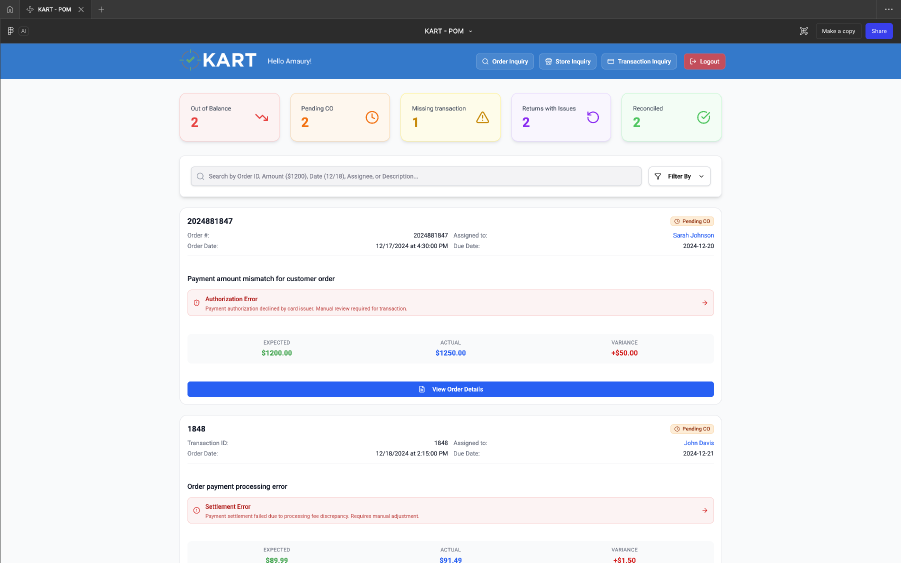
Order Health & Fix screen
Order Health — anomalies auto-flagged, prioritized by state, with expected/actual variance in view
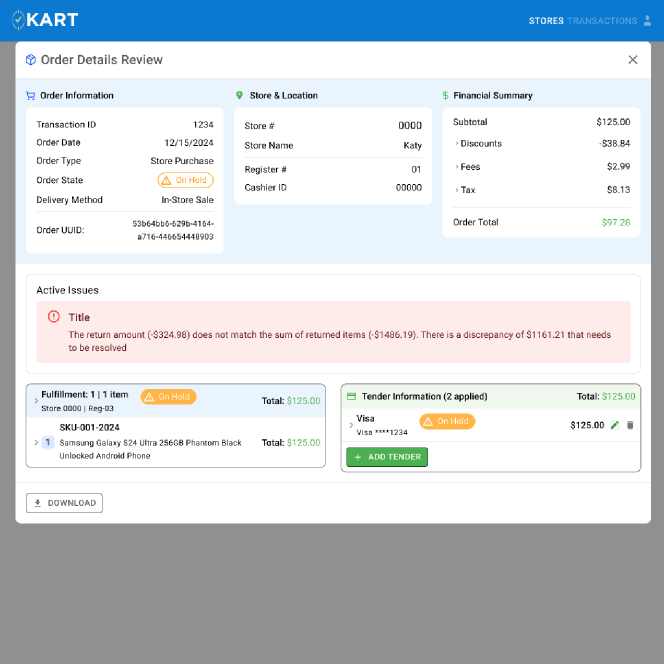
Order Details Review prototype screen
Order Details Review — active issues surfaced inline, with guarded tender edits and audit trail

Because most auditors work on a single screen, the experience was rebuilt around progressive disclosure: drill into items, tenders, and returns without losing your place or triggering full page reloads — review, fix, and confirm on one screen.

What I’d tell other designers about AI
“AI works anytime — but it will never understand your users as you do. Research is what makes the output worth shipping.”
Invest in strong prompt creation: objectives, constraints, data fields, roles, success criteria
Bind AI output to an existing design library so it lands on-brand, on-token
Keep a grounding loop with Figma for components, naming, and tokens
Do the research first — clarity in, quality out
Reflection

Comfortable with the uncomfortable.

This project started with no clear scope, no shared vocabulary, and a data model even the team found hard to explain. The discipline was the same as ever — evidence before opinions — but AI changed the tempo: discovery fed the prototype, the prototype fed the conversations, and the conversations set a prioritized MVP that engineering could start building on time. The full experience has since shipped.

Ambiguity isn’t a blocker. It’s the raw material of the job.