Case study · Kohl’s · Enterprise tooling · Accessibility

SPM — retiring the legacy, by design.

Kohl’s ran ~$1.5 billion in annual store payroll budgets — its single largest SG&A line — through Excel and a tool Rube-Goldberg’d together over ~15 years on two legacy platforms that cost roughly $4.8 million a year to keep alive. I designed the greenfield platform that replaced them — intuitive, accessible, and built to scale — piloted in the field and launched in October 2024.

ROLE
Product Designer II
TEAM
Workforce Optimization · Eng · SOE Finance & Analytics
USERS
Store & district managers · corporate teams
LAUNCH
Piloted in 2 districts · live Oct 2024
$4.8M/yr
combined run cost of the two legacy platforms — Teradata (EDW) and MicroStrategy — that SPM lets Kohl’s retire
~$1.5B
in annual store payroll budgets — Kohl’s single largest SG&A line — now on one modern platform
Accessible by design
palette tuned for protanomaly (red-deficient) vision, usability-tested for data readability
The problem

A billion-dollar budget, managed in Excel.

For roughly 15 years, store payroll budgets flowed through a legacy tool Rube-Goldberg’d together on two platforms — Teradata (EDW) and MicroStrategy — and stitched with spreadsheets. It was expensive to keep alive, hard to navigate, and could not adapt to modern economic and operational demands.

The people using them — store and district managers — struggled to extract meaningful insight from the data at all.

$4.8Ma year to run the two legacy platforms, Teradata (EDW) and MicroStrategy
~$1.5Bin payroll budgets — Kohl’s single largest SG&A line company-wide
~15 yrsof legacy tooling and process to unwind without disrupting a payroll cycle
Research & discovery

Listening to the people who close the books.

User interviews with store & district managers

Understood their real needs and daily challenges — where the current tools slowed them down and what “useful” actually looked like at store level.

Payroll process mapping

Mapped the payroll workflow end to end with finance, analytics, and engineering to find inefficiencies and opportunities for optimization.

KEY FINDINGS
Users wanted clearer data visualization and better navigation — not more features.
The legacy system fundamentally could not adapt to modern economic and operational demands — redesign, not repair.
The solution

A platform managers can read at a glance — including the 1 in 12 who are colorblind.

Widget-based interface

Simplified navigation, filtering, and data access — payroll budget insight without spreadsheet archaeology.

Accessibility as a requirement

Palette researched against protanomaly (red-deficient) color vision, then usability-tested for widget design, filtering, and data readability — not retrofitted later.

Built for what’s next

A greenfield system of record, fully decoupled from EDW and MSI and built on enterprise data-governance standards — ending the cycle of dependence on aging tech.

Before
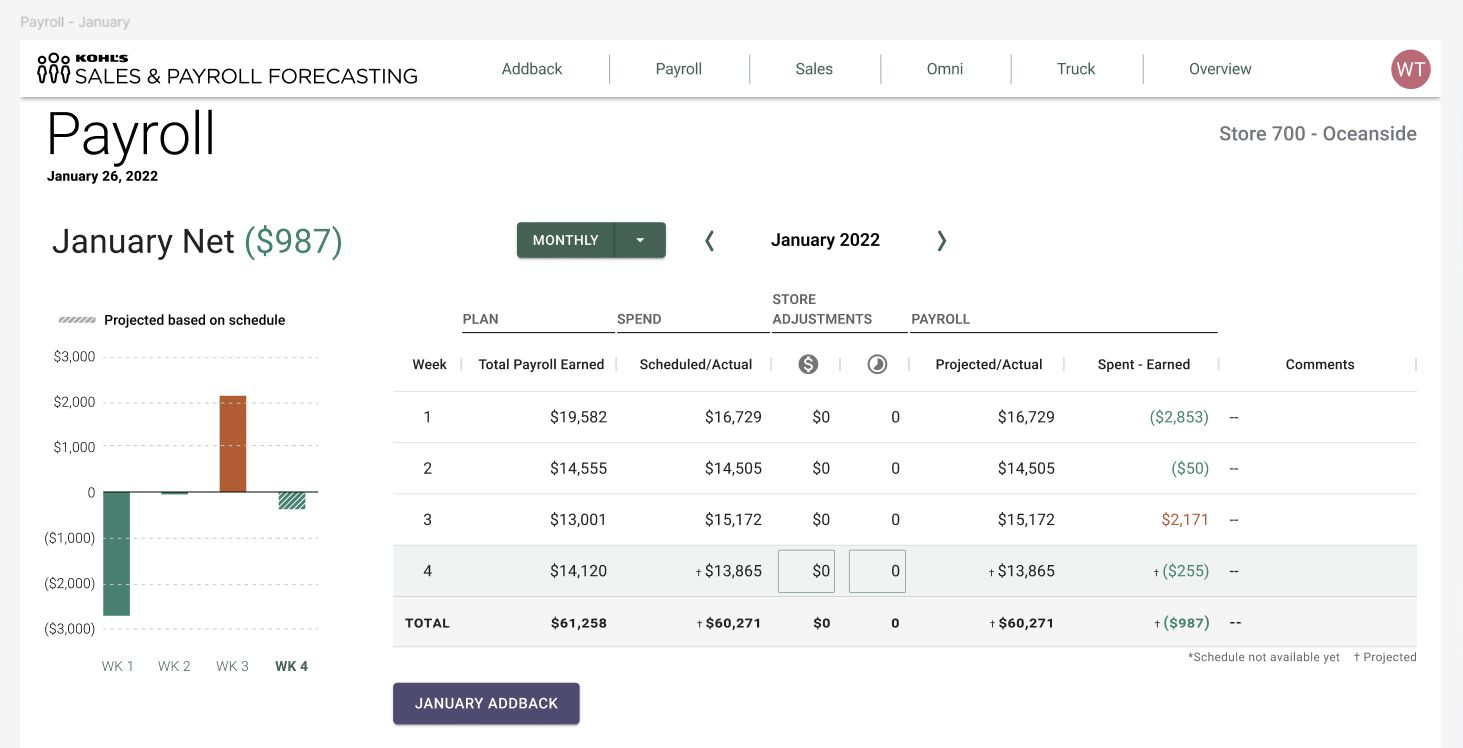
The legacy Sales and Payroll Forecasting application
The legacy Sales & Payroll Forecasting app — dense tables, hard to read at a glance.
After
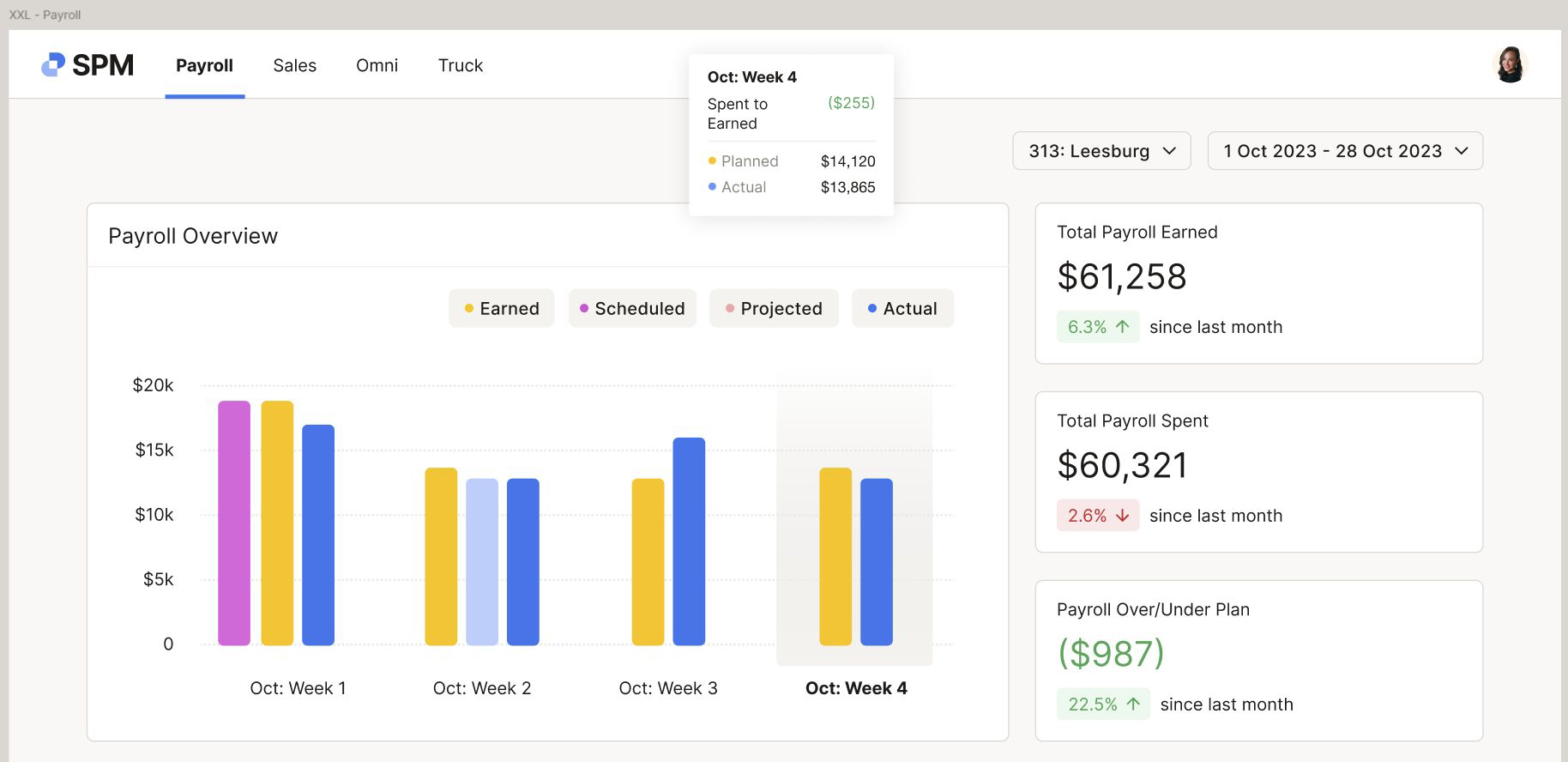
SPM Payroll Overview dashboard
SPM’s Payroll Overview — plan vs. actual, spend, and variance at a glance, on the colorblind-safe palette.

I led the design process in Figma with iterative usability testing throughout. The platform was piloted in two districts for two weeks (Sept 22–Oct 5), refined on field feedback, then launched to the full fleet on Oct 6 — fiscal October 2024.

Results

The legacy systems are gone. The savings are permanent.

$4.8 million in annual run cost removed — Teradata EDW and MicroStrategy fully decommissioned
SPM became Kohl’s new system of record for store payroll budgets, fully decoupled from the legacy stack
Improved navigation, readability, and accessibility — greater efficiency in managing payroll budgets
User feedback reported significant gains in clarity and ease of use over the previous system
Reflection

Enterprise tools deserve consumer-grade care.

The business case was cost — but the design case was dignity: store managers handling billion-dollar budgets deserved tools as considered as anything customer-facing. Accessibility wasn’t a compliance checkbox; it was the difference between a dashboard everyone can read and one that quietly excludes.

Replacing a system is easy to promise and hard to land. Piloting in the field before launch is what made the transition seamless.